Here’s what I learned at the sessions and keynotes during 26NTC. I need to include a massive disclaimer that there were many more sessions than any one person could attend, and that I wasn’t able to hear every keynote in its entirety.
Tuesday’s keynote from Anil Dash
I was intrigued by Anil Dash’s exploration of power and who has it, tracing how at every level of leadership in a company or organization, someone else above them has more power.
- No matter how far up the ladder you climb, everyone answers to someone else
- Workers, managers, directors, VPs answer up to the CEO, who answers to a board of directors, which answers to private equity, which answers to government regulation and legislation, and so on.
- True power lies with the workers, who influence public opinion and civic action, which in turn causes the government to act.
Let’s hope we exert this power in greater numbers and don’t buy into the myth, fears, and pressures of capitalism that tell us that workers actually do not have power. I’m going to be thinking about this for a while.
In addition to power to influence government, workers can also influence nonprofit technology by building our own tools instead of solely relying on tools made by companies that may or may not share our values. With the advent of AI, it’s more possible for more people to do this than it previously was. This framing gave me a great foundation for how to think about everything else I attended for the rest of the conference.
Branding Your Giving Programs to Attract, Retain, and Upgrade Donors
This session was presented by Farra Trompeter and Claire Taylor Hansen of Big Duck, and Ishmam R. Rahman from International Rescue Committee. I said in NTC 2026 Recap Part 1 that there is value in the community and belonging we find at NTEN, and the same is true for donors and giving programs.
- Big Duck and IRC surveyed and interviewed donors to understand their motivations for donating
- They used their findings to reimagine their giving programs with new names, designs, and value-adds for donors that build community and identity
- Retention improved by significant amounts, and the donor experience also improved
Ishmam shared that this rebrand is now in its third year, and the process of change never really ends. It’s helpful to know that major changes need a long view, and a state of continuous improvement is actually the end goal, rather than ever being “done.”
I was struck by the parallel between that and a technology stack. A nonprofit’s tech stack isn’t ever “done,” either; the tech stack and strategy is a product that needs continuous assessment and improvement.
M+R’s Scout Quest: Unearthing Your Data’s Hidden Gems
Lia Mancuso presented about Scout Quest, M+R’s data co-op that has delivered great results for nonprofits who wish to reactivate dormant subscribers for email and advertising. Acquisition is expensive and getting harder as people continue to be overwhelmed by their inboxes.
One great thing about reactivating inactives is that you know they were interested in your mission at one point. It’s a second chance to do better at engaging former subscribers and keeping their interest.
Sidenote: This wasn’t part of the Scout Quest session, but I’ll add that I have been finding a great deal of value in the Civic Shout Newsletter, produced by Sara Cederberg. Twice a week there are very practical strategies for how to do better email engagement and activation. So if you think you may have lost some subscribers because they got bored of your emails 5 years ago, you have a chance to really wow them when you reactivate them. Read the Civic Shout newsletter archives; it’s like getting a master’s degree in effective email marketing for nonprofits.
Sidenote to the sidenote: a tip Charlotte and I received when we started Raise HECK was to produce things that add value that you make available for free. The Civic Shout newsletter is one such thing, and hat tip to Josh Nelson and Civic Shout leadership for making this happen. Is it really only 7 months old?
The Great Debate: Generative AI and the Future of the Social Impact Sector
Cool Slash Scary AI hosted a debate! Pam Trzop from Stratovation Partners moderated a showdown between Rachel Kimber of Full Circle Impact Solutions and Craig Johnson of Change Agent AI debated Ben Miller from Bonterra and Cheryl Contee of BrightWorks AI. The statement: “Nonprofits that fail to adopt generative AI in the next 5 years will fail to compete for funding and talent.” (I may have paraphrased that inaccurately, let’s call it a hallucination if so.) Anne and Craig were CON; Ben and Cheryl were PRO.
The debate format was really fun! It kept the back and forth discussion lively. From what I heard, the four participants were all friends, but I would never have known it just from listening to their debate. It was respectful, and/but passionate. The passion and the definitive statements, arguments, and rebuttals kept me awake and attentive.
If you have a chance to attend an event organized by Cool Slash Scary AI, take it! And if it happens to be the Great Debate format, you’re in for a treat.
- FWIW, I started on the CON side and ended there after the debate, but I do think nonprofits will compete better if they can thoughtfully adopt generative AI with governance, clear policies, and by keeping decisions and content firmly centered with humans.
- I also think that nonprofits that adopt generative AI in a haphazard way without guardrails and security will not only fail to compete, but may be in for some spectacularly bad outcomes.
Making Data Fun!
This session was presented by COMPASS Youth Collaborative’s Isaiah Jacobs, Elizabeth Giannetta, and Mica Smith. COMPASS interrupts violence in the City of Hartford, Connecticut by building transformative relationships with youth at the center of the violence.
True to their word, COMPASS brought the fun. They shared how COMPASS built a positive data culture at their organization. By meeting staff where they are in terms of their data literacy journey, and by bringing games and play into the data conversation, they shared how they work to demystify data so everyone can make use of it in their roles.
For the second half of the session, we broke into small groups and played data games. Charty Party is a card game similar to Apples to Apples. Part of playing the game involves understanding how the chart and the possible answers could fit together, with humorous results. We also played a game of elimination similar to 20 questions to identify a specific data point from a list.
Both game experiences built camaraderie in our group of strangers, and I could easily imagine myself working at a nonprofit organization, playing data games, and then taking on a shared task like data mapping or de-duping with a lot more enthusiasm after the game play. Data really is fun!
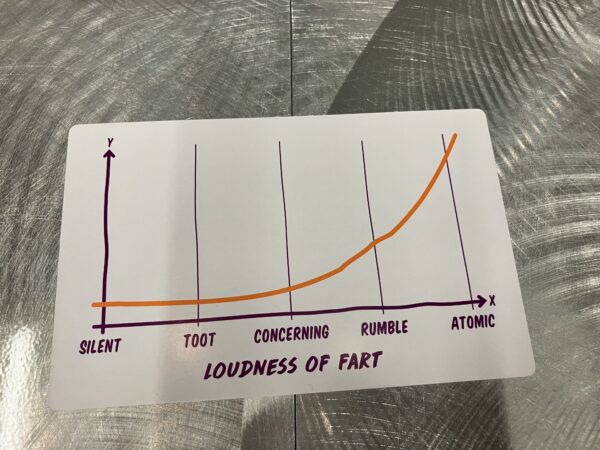
A card from Charty Party, a fun data-themed game!
Keynote from Sasha Costanza-Chock
One theme I heard during Sasha Costanza-Chock’s keynote was that many of the AI tools that are in use to purportedly increase security and safety actually cause harm. This harm can occur in many circumstances, one of which is when TSA airport body scanners consistently flag bodies that don’t conform to pre-programmed expectations of gender. Another circumstance is if AI is used by the military to identify targets, and if the data used to train that AI is incorrect or outdated, and if a human didn’t reality-check the target.
These are horrifying consequences. Against the backdrop of how AI has rapidly proliferated, and how it feels inevitable that it will permeate every facet of technology and life, it can feel daunting. Especially since for most people and companies, the AI tools that are available to us are the ones produced by big for-profit tech companies.
More than once during NTC I heard Audre Lorde’s quote “the master’s tools will never dismantle the master’s house,” and in this context leads me to question whether AI tools developed by Big Tech with all the surveillance, extraction, copyright violation, and white supremacy they have baked in can actually help create a better world–or whether they will simply cause more harm.
But that doesn’t have to be the only future. With a different model, data could be cooperatively owned and AI could be a shared human resource to prioritize community well-being, rather than a tool for corporate extraction. I’m still wrapping my head around this and intend to dive into this report: AI Commons: nourishing alternatives to Big Tech monoculture by Joana Varon, Sasha Costanza-Chock, Mariana Tamari, Berhan Taye, and Vanessa Koetz.
Unlocking the Power of Donor-Advised Funds
This session was presented by Mitch Stein of Chariot and Karin Kirchoff of K2D Strategies. I’m not embarassed (well, maybe a little) to say that previously I haven’t thought too deeply about DAFs. Raise HECK has advised clients on best practices for how to record DAF gifts in their CRM, usually before or after a migration. Besides that, I mainly thought it was just another vehicle for wealthy people to stash their cash while they decided where to make donations.
But after attending this session, my eyes are open! Here are a few takeaways:
- Some people have a DAF to organize their giving so their tax receipts are all in one place. This hit home: every year at tax season I’m searching my Gmail for the phrase “thanks for your gift” and “tax-deductible donation” to find out where I donated. I know I have inevitably missed some.
- DAF donors give more and have better retention rates. This makes sense from a practical standpoint and also, probably, a psychological standpoint. The money in your DAF is there and can only be used for 501c3 donations, so the decision to give has already been made. Interestingly, 92% of DAF gifts were under $5,000, meaning DAFs are doing a lot of work for mid-level donors.
- Friction is a barrier to DAF usage. Since DAF donors tend to give more, it makes sense to work to remove barriers, especially for online giving (get the DAFPay button and software providers, integrate it into your tools!), and especially since many mid-level donors give online. Also, the ol’ QR code can play the hero here, giving DAF holders a quick and easy way path toward making a gift, both at events and in mass marketing communications.
If you haven’t read the DAF Giving Report, you can download it here. Do that, and when Karin and Mitch do a webinar for the 2026 report, make sure you attend it to hear their comments firsthand. It will be time well spent.
Questions? Comments? I’d love to hear your thoughts. Here’s my LinkedIn thread about NTC.
Read the other NTC 2026 Recaps from Raise HECK:
NTC 2026 Recap Part 1: Reflections on NTC and the Value of Community
NTC 2026 Recap Part 3: How to Lead Through Tech Change